<img alt="" src="https://secure.redd7liod.com/155840.png" style="display:none;">

Our services are intended for developers and owners who know from experience that engineering is not a commodity and understand the importance of saving time and money throughout the life of a project.

PPEs unrivaled expertise, large in-house team, high quality engineering and nationwide footprint allow our clients with large portfolios to trust that engineering work is done accurately and efficiently so they have minimal concerns about meeting the requirements of an AHJ’s codes or standards.

image 16 (2)
image 16 (11)

Load Flow Studies

Pure Power will analyze the part of the solar + storage system that specializes in maximum steady state AC current or AC power.

The load flow study determines voltage and current at buses and cables. It is used mainly to verify equipment and conductor ratings.

image 16 (12)

Reactive Power

Similar to load flow, this analysis specializes in maximum steady state AC current or AC power but with an emphasis on the phase relationship between voltage and current.

The reactive power study looks at the ability of the PV generation station to meet the utility requirements for power factor and voltage at the POI under varying utility voltage conditions.

image 16 (13)

Short Circuit

Pure Power will perform a short circuit analysis of the solar + storage system which is used to determine the available fault current at each device in the electrical system under study.

The available fault current at a device is a function of the available fault current from all sources—including the utility, PV inverters, ESS inverters, motors as well as the impedance between those sources and the device.

image 16 (14)

Cable Thermal Ampacity

Pure Power will perform an analysis of underground or overhead AC & DC circuits which analyzes the impact of the thermal environment on cable ampacity.

The information from this study is used to size the cables and design cable arrangements (a separate report version can be performed for DC circuits).

image 16 (9)

Arc Flash

PPE will evaluate the potential arc flash incident energy at points in the system where work on live equipment might be performed.

The result of an arc flash study is a series of warning labels that get applied to each piece of electrical equipment in the system. This label defines the arc flash boundary as well as the incident energy at some distance from the equipment. 

image 16 (10)

Grounding (Ground Grid)

We will perform a ground grid study of the grounding system to determine the ground potential rise, step and touch potentials on the site as well as the maximum step and touch potentials.

The ground grid system will be designed to reduce step and touch potentials below the maximum allowed values. 

image 16 (15)

Lightning Risk Assessment

PPE will perform an analysis of the solar + storage system and determine the probability that a lightning strike will cause damage.

The results of this report can be used to justify the addition of lightning protection equipment for the solar + storage system.

image 16 (16)

Equipment Evaluation

Pure Power will perform an analysis of the solar + storage system that compares the short circuit capability of equipment versus the short circuit capability from the utility.

The results of this report will validate the capability of the equipment to withstand faults. (a separate report version can be performed for DC circuits)

Featured Articles

blog

NEC 2026 - The Code Changes That Matter Most for Solar Developers and EPCs

The 2026 edition of the National Electrical Code (NEC) introduces a wide range of updates that affect how solar PV ...

Read More
blog

6 Practical Insights for Standalone Battery Energy Storage System (BESS) Design

Driven by grid stability & reliability needs and by the integration of renewables, Standalone BESS (battery energy ...

Read More
blog

The Power of Interconnection Planning - Why Solar Developers Need PSCAD, PSS®E, and ASPEN Expertise

Interconnection queues are more congested than ever, and the path to approval is increasingly opaque. Developers are ...

Read More

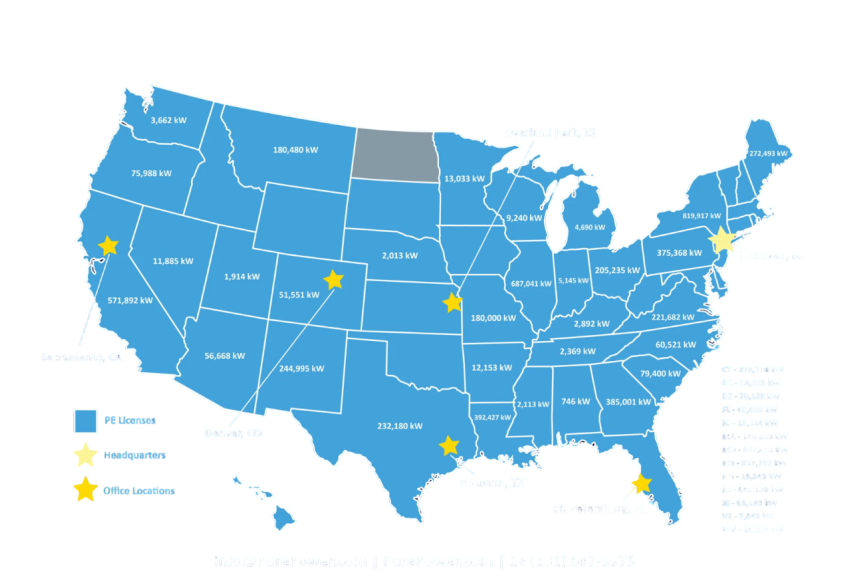
Nationwide Footprint

We are a single firm that can meet your needs everywhere you are developing or installing. 

130+

In-House Engineers

3,400+

Solar & BESS Designs 100KW+

17,000+

Project Touchpoints

58+

Project Managers and PEs

image 9

Related Videos

Why Developers & EPCs Need to Prioritize Power Studies for All Solar + Storage Projects

https://youtu.be/AKAWvDKl18U

Value Engineering Tips See More

The 2026 edition of the National Electrical Code (NEC) introduces a wide range of updates that affect how solar PV systems are designed, installed, and inspected. While many revisions are editorial or structural, several changes have real..

Driven by grid stability & reliability needs and by the integration of renewables, Standalone BESS (battery energy storage systems) are moving from pilot to mainstream. But anyone who has tried to develop or engineer one, especially in dense, highly..

Interconnection queues are more congested than ever, and the path to approval is increasingly opaque. Developers are spending serious money on land control, studies, and legal work, only to hit delays when grid studies surface surprises late in the..

In the public eye, there is hardly a conversation about utility-scale solar without addressing the fear of losing valuable farmland. Debates with community involvement tend to be polarized. Developers see open fields as ideal for solar, while..